5 November 2026 Time to read: 9 minutes
PLA, PETG, ABS or ASA? How to Choose the Right 3D Printing Material
What the same wall bracket costs in all six materials we print, and how each one copes with heat, sun, knocks and load.
Choosing the material is the most important decision when you order a 3D printed part. The same shape can last for years in one material and lose its shape within a week in another. A phone holder made of PLA, for example, can warp on a car dashboard on the first hot day, while the same holder in ASA stays as it is.
We print in six materials: PLA, PETG, ABS, ASA, TPU and PAHT-CF. For most parts, one simple rule is enough: PLA for things you look at, PETG for things you use. The other four are for parts that face heat, sun, bending or a real load.
The six materials at a glance
| Material | Best for | Not for | Keeps its shape up to about | Price |
|---|---|---|---|---|
| PLA | Decorative pieces, figures, prototypes | Heat, sun and parts that take knocks | 55 °C | Lowest |
| PETG | Everyday functional parts | Hot cars and years in strong sun | 70 °C | Low |
| ABS | Tough indoor parts that get warm | Long-term use outdoors | 90 °C | Medium |
| ASA | Outdoor parts and parts in the sun | Parts that have to bend | 90 °C | Medium |
| TPU | Flexible parts such as bumpers, grips and pads | Stiff parts and parts that carry a load | Usually not listed (it's flexible) | High |
| PAHT-CF | Strong, stiff parts that carry a load or sit near heat | Tight budgets and colours other than black | Over 150 °C | Highest |
The temperatures are typical values from filament makers' data sheets, and they differ a little from brand to brand. A part that carries a load can start to soften a bit earlier, so leave yourself some margin.
Same part, six materials: real prices
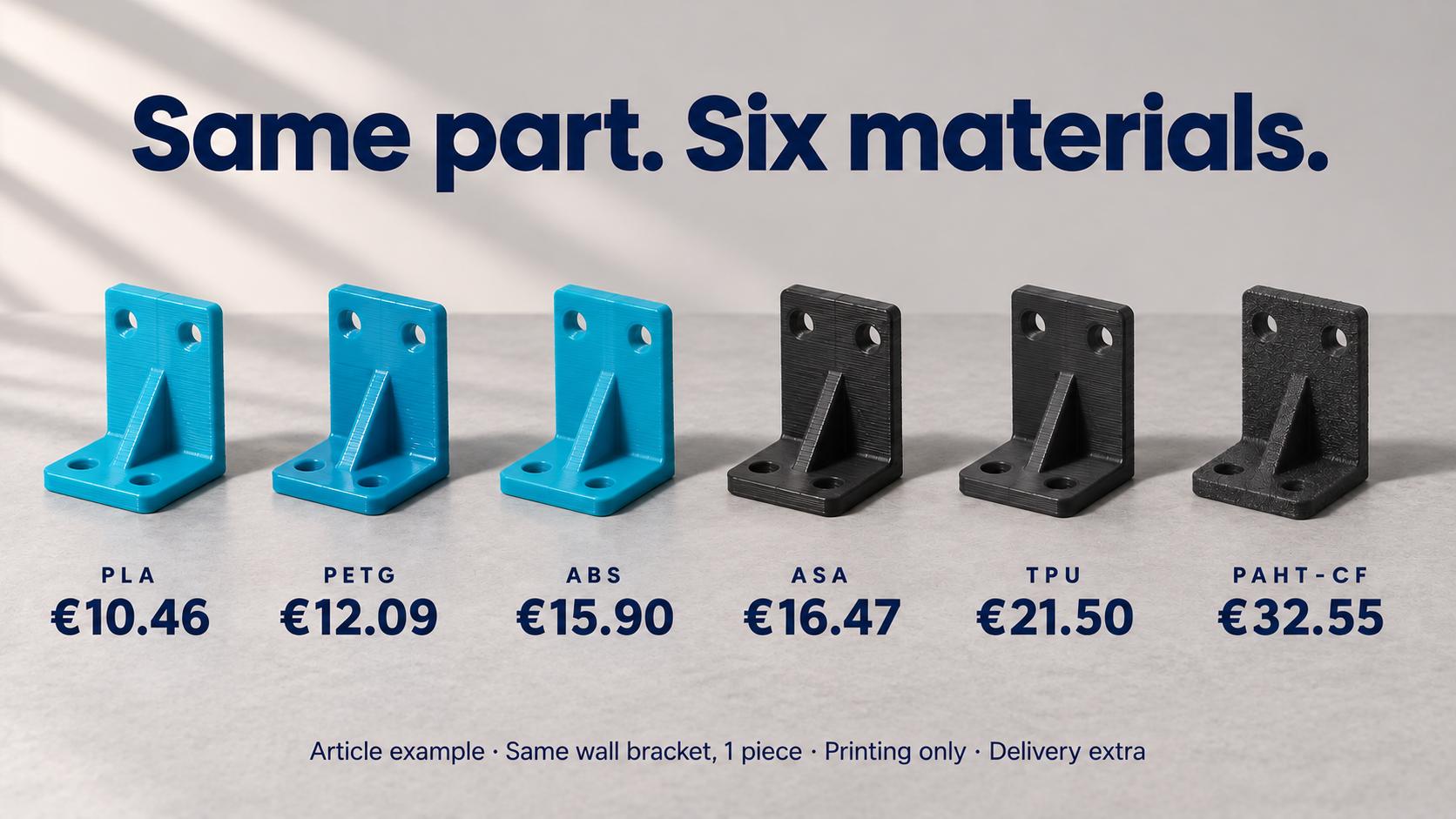
To show how much the material changes the price, we took one typical part and ran it through the same slicing and pricing system our quoter uses, in October 2026. The part is an L-shaped wall bracket, 60 × 40 × 50 mm, with a stiffening rib and two screw holes on each side. It was priced with the quoter's standard settings: 0.2 mm layers, 15% infill and 3 walls.
| Material | Weight | Print time | 1 piece | Each, if you order 10 |
|---|---|---|---|---|
| PLA | 19.6 g | 39 min | €10.46 | €3.91 |
| PETG | 19.4 g | 46 min | €12.09 | €4.85 |
| ABS | 16.3 g | 43 min | €15.90 | €6.06 |
| ASA | 17.0 g | 43 min | €16.47 | €6.30 |
| TPU | 18.0 g | 1 h 50 min | €21.50 | €11.92 |
| PAHT-CF | 16.8 g | 1 h 25 min | €32.55 | €16.38 |
The prices are for printing only, before delivery and before any running promotion. We don't currently charge VAT, so nothing is added on top. Ordered on its own, a single PLA or PETG bracket would be topped up to our €15 minimum order value.
The price follows the material, not the weight. The bracket is lightest in ABS, because ABS is a lighter plastic, yet it costs about 50% more than in PLA. TPU and PAHT-CF cost the most because they print slowly, and carbon fibre nylon is also the most expensive filament to buy. PETG costs only €1.63 more than PLA here, which is usually worth it for a part that gets used every day. When you upload your own part, the quoter shows what it would cost in each of the other materials, so you can compare for yourself.
What will the part have to cope with?
The easiest way to choose is to think about where the part will be used and what it has to put up with.
Heat
Heat is the most common reason a 3D printed part fails, and PLA's 55 °C is lower than most people expect. A closed car parked in the sun gets much hotter than the air outside: in a 2018 study by Arizona State University, car dashboards averaged about 69 °C after one hour in the sun.
Indoors at room temperature, any of the six works. Near electronics, motors or lamps, PETG is fine if they only get a little warm, and ABS or ASA if they get properly warm. In a car, use ASA, which also handles the sunlight coming through the windows. Next to hot machine parts, PAHT-CF keeps its shape at well over 150 °C.
Sun and rain
UV light makes most plastics fade and turn brittle over time. ASA is made for this: it keeps its colour and strength outdoors, which makes it the right choice for garden parts, outdoor housings, signs and car parts. PETG handles rain and damp well and copes with some sun, but after long periods in strong sun it can fade and become brittle, so it suits parts in the shade or parts that are only outside now and then. ABS turns yellow and brittle in sunlight and belongs indoors. PLA isn't meant for outdoor use either. It won't rot in the rain, though: PLA only breaks down in industrial composting, not in your garden.
Bending and knocks
TPU is the only flexible material we print. It feels like rubber, bends and springs back, and is very hard to tear or wear down, so it's the material for bumpers, grips, protective covers, feet and pads. PETG, ABS and ASA are rigid but tough: they take knocks well, and when overloaded they usually bend before they break. PLA is stiff and holds fine details well, but it's brittle, and a hard knock or bending it too far can snap it.
Load
PAHT-CF is the strongest and stiffest of the six. In one of our customer projects, a ribbed camera rig mounting plate printed in PAHT-CF held a 500 kg load in the customer's own test without breaking. For most brackets and holders, though, PETG, ABS or ASA are enough, especially with extra walls.
A stronger part doesn't always need a more expensive material. The outer walls carry most of the load, so add walls before you change material or add infill. With the quoter's Strong option (5 walls and 40% infill), the PETG bracket above costs €12.85 instead of €12.09, while switching it to PAHT-CF almost triples the price. Our guide How much does 3D printing cost? explains why walls usually help more than dense infill.
A 3D printed part is also weakest between its layers. If your part will be pulled or bent in one particular direction, mention it in the special instructions when you order.
Water, oil and chemicals
PETG resists water and many common chemicals, including alcohol. PAHT-CF handles oils and many chemicals well. ABS and ASA can be damaged by some solvents, such as acetone.
Printed parts aren't guaranteed to be watertight, because water can sometimes find its way between the layers. If your part has to hold water or seal tightly, get in touch before you order.
Food
None of our materials are certified as food-safe. Food can also get stuck in the fine grooves between printed layers, which makes printed parts hard to clean properly. For cups, plates, kitchen utensils and anything else that touches food or drink, choose a product made for food contact instead.
Looks
PLA gives the smoothest surface and the sharpest details, and it has the widest choice of colours, followed by PETG. PAHT-CF has a dark, matte surface because of the carbon fibres in it. For small details, choose the quoter's Fine detail option, which prints in thin 0.12 mm layers. The quoter always shows which colours are available for each material right now.
Size
The maximum size depends on the material. We print parts up to 500 mm on each side in PLA and PETG, up to 400 mm in ABS and ASA, up to 350 mm in PAHT-CF and up to 300 mm in TPU.
PLA vs PETG: which is better?
Neither is better overall. They're good at different things:
| PLA | PETG | |
|---|---|---|
| Surface and details | Smoother, sharper details | Good, slightly less crisp |
| Stiffness | Stiffer | Slightly flexible |
| Knocks and drops | Can snap | Bends before it breaks |
| Heat | Softens at about 55 °C | Keeps its shape up to about 70 °C |
| Outdoors | Not suitable | Fine for some sun and rain |
| Colours | Widest choice | Good choice |
| Bracket example, 1 piece | €10.46 | €12.09 |
Choose PLA for display models, figures, prototypes and indoor items that don't get knocked around. Choose PETG for parts that get handled every day, get wet or sit somewhere warm.
ABS vs ASA: what's the difference?
ASA is a close relative of ABS, developed for outdoor use. Both are tough, cope well with heat and cost about the same. The difference is sunlight: ABS turns yellow and brittle in the sun, while ASA keeps its colour and strength.
Indoors, both work well. ABS currently comes in more colours, and in our bracket example it was slightly cheaper (€15.90 against €16.47). Outdoors and in cars, ASA is the one to pick.
Frequently asked questions
Which is stronger, PLA or PETG?
It depends on what you mean by strong. PLA is stiffer and can take a little more in a straight pull, but it snaps suddenly when it's overloaded. PETG bends before it breaks and copes much better with knocks. For parts that get used every day, PETG is usually the safer choice.
Can I use PLA for functional parts?
Yes, as long as the part stays indoors, doesn't get warm and isn't knocked around much. Organisers, simple holders and test pieces work well in PLA.
Which material should I use for car parts?
ASA, inside the car and outside, and PAHT-CF for stiff parts that have to carry a load. Don't use 3D printed plastic for parts your safety depends on, such as brakes, steering, seat belts or child seats.
What does PAHT-CF mean?
PA stands for polyamide, better known as nylon. HT means high temperature, and CF means carbon fibre. PAHT-CF is a heat-resistant nylon filled with short carbon fibres, which make it very stiff and strong while keeping it light.
Still not sure?
Get in touch, tell us what the part is for and where it will be used, and we'll help you choose. Our materials page has more about each material, and if this is your first order, our guide How to get something 3D printed without a printer takes you through it step by step.
Ready to price your part? Upload a file and get a quote in a few moments.
Open quoter