5 October 2026 Time to read: 9 minutes
How Much Does 3D Printing Cost? Real Prices and What Sets Them
Three parts we priced in our quoter show why weight says little about the price of a 3D print, and what really changes it.
A small PLA mounting bracket costs about €9 to print. A PETG electronics enclosure costs about €15, and a carbon fibre nylon motor mount about €44, even though the motor mount weighs less than the enclosure. Weight is only one part of the price.
Real price examples
We designed these three parts and priced them in October 2026 with the same slicing and pricing system our quoter uses:
| Part and size | Material | Weight and print time | 1 piece | Each, if you order 10 |
|---|---|---|---|---|
| Small mounting bracket, 40 × 30 × 30 mm | PLA | 8 g, 25 min | €9.02 | €2.56 |
| Electronics enclosure with screw posts, 100 × 70 × 40 mm | PETG | 49 g, 1 h 12 min | €15.35 | €7.92 |
| Motor mount with stiffening ribs, 80 × 60 × 60 mm | PAHT-CF | 36 g, 2 h 24 min | €44.15 | €27.29 |
All three use the quoter's standard settings: 0.2 mm layers, 15% infill and 3 walls. Weights and times are the slicer's estimates. The prices are for printing only, before delivery and before any running promotion. We don't currently charge VAT, so nothing is added on top.
The motor mount costs almost three times as much as the enclosure because carbon fibre nylon is a more expensive material and the part takes twice as long to print. The bracket shows what quantity does: ten of them cost €2.56 each instead of €9.02, mostly because the setup cost is shared between them.
What the price is made of
Every price has three parts. Print time is how many hours the printer spends on your part. Material is how many grams of filament it uses, and which filament it is. The setup cost is a fixed amount for each model in your order. It covers checking the file, preparing the printer and the final quality check, and if you order several pieces of the same model, it's split between them. Quantity discounts and any running promotion are applied after that.
The hours and grams aren't guessed from the size of the model. When you upload a file, the quoter prepares it for printing with exactly the material and settings you chose. It's the same step that happens before every real print, and it's called slicing. The time and material in your price come from that print plan.
Why price per gram gets it wrong
Many calculators multiply a model's weight or volume by a fixed rate. It's simple, but two parts of the same weight can take very different times to print. A tall, thin part needs far more layers than a flat one. Sections that stick out with nothing underneath often need supports, which take time and material and are removed after printing. Thicker walls add time without changing the outside of the part at all.
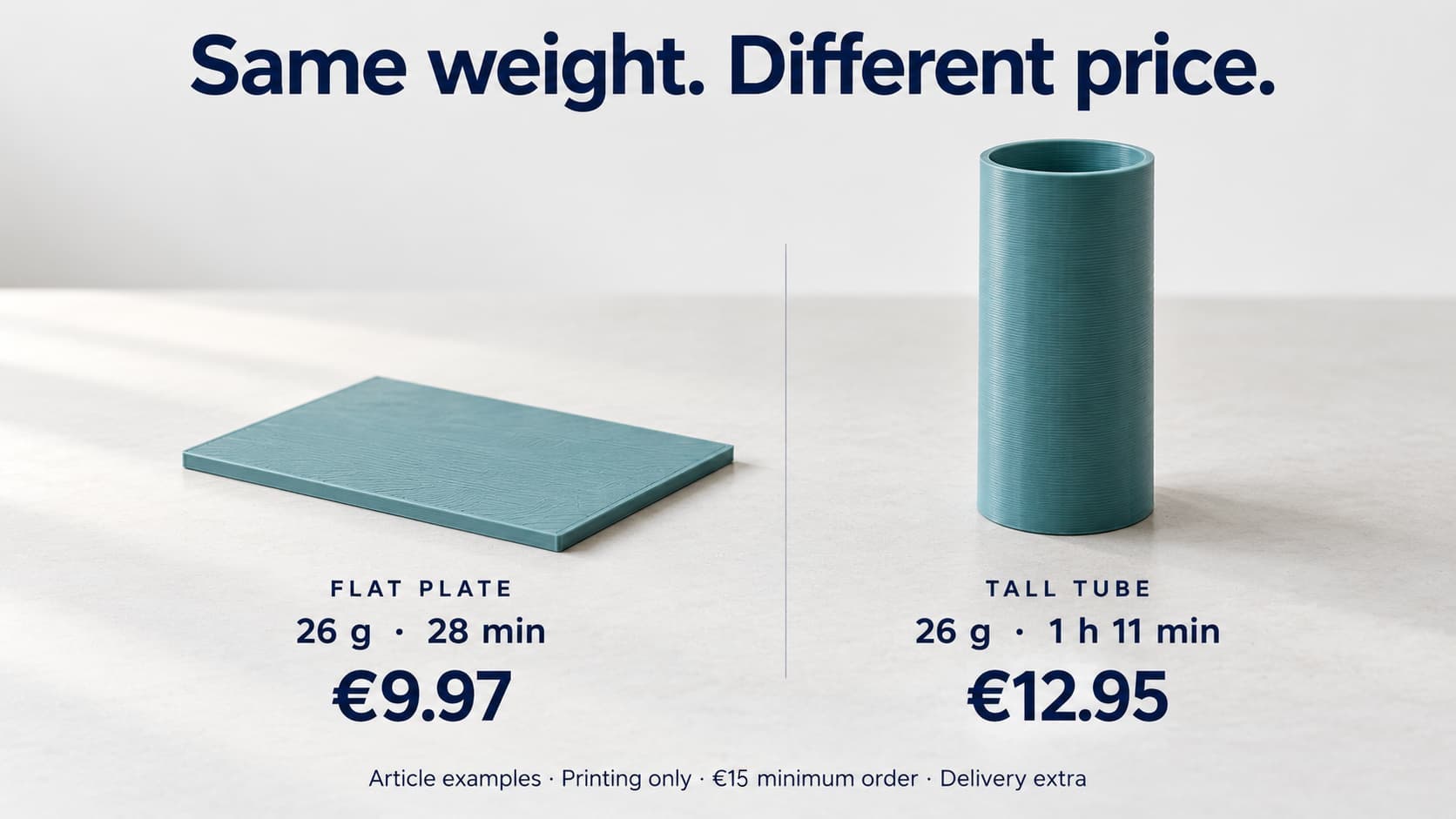
The image at the top of this article shows a test we ran. Both parts weigh 26 g. The flat plate (120 × 80 × 4 mm) prints in about 28 minutes and costs €9.97. The tall, thin tube (40 mm wide and 100 mm high) takes about 1 hour 11 minutes and costs €12.95. A price per gram would charge the same for both.
Bigger prints work the same way. On one real quote of about 844 g of material and almost 28 hours of printing, more than 40% of the time went into the walls, about a quarter into supports and less than a fifth into all of the infill together.
7 things that decide the price
1. Size and height
A bigger part uses more material, and every extra millimetre of height adds more layers. We print parts up to 500 mm on each side in PLA and PETG, and between 300 and 400 mm in the other materials. Once any side is longer than 250 mm, the thinnest layer we offer is 0.2 mm, which keeps print times for big parts reasonable.
2. Material
PLA is the cheapest, and PETG costs only a little more. ABS and ASA are in the middle. TPU costs more because flexible filament has to be printed slowly, and PAHT-CF, a nylon reinforced with carbon fibre, is the most expensive: the filament itself costs more, and it prints slowly too.
| Material | What it's used for | Price compared to the others |
|---|---|---|
| PLA | Display models, prototypes, decorative pieces | Lowest |
| PETG | Everyday functional parts, protective housings | Low |
| ABS | Indoor housings and functional prototypes | Medium |
| ASA | Outdoor parts that can handle sun and weather | Medium |
| TPU | Flexible parts such as bumpers, grips and pads | High |
| PAHT-CF | Strong brackets and technical parts | Highest |
If the part stays indoors and doesn't carry much load, PLA or PETG is usually enough, and there's no point paying for a technical filament it doesn't need. Our guide on choosing a 3D printing material compares all six with real prices, and the materials page has more about each one.
3. Walls and infill
The wall count (2 to 8 in our quoter) sets how thick the outer shell of the part is, and the infill density (5% to 100%) sets how solid it is inside. For most parts, the walls do more for strength. One or two extra walls usually help more than going up to 80 or 100% infill, which makes the print much longer and uses a lot of material without making the part much stronger.
4. Layer height
Layer height (0.08 to 0.28 mm) decides how smooth the surface is. With thinner layers the lines are less visible, but the printer has to make more of them, so it takes longer. For functional parts, a medium or thicker layer looks fine and costs less. Thin layers are worth it for parts where looks or small details matter.
5. Shape and supports
Sections that lean outwards only slightly usually print fine without supports. The closer they get to flat, the more likely they are to need them, and details hanging in mid-air almost always do. Our system turns the model to a position that needs fewer supports, but the shape itself still makes the biggest difference. Angled edges instead of flat ledges mean fewer supports and a shorter print. Thick, solid sections that don't need to be solid are worth making thinner or hollow too, because they cost material and time.
6. Quantity
Ordering several pieces of the same model lowers the price per piece in two ways: the setup cost is split between them, and the quoter applies quantity discounts automatically.
| Pieces of the same model | Discount |
|---|---|
| 1 to 2 | Standard price |
| 3 to 9 | 3% |
| 10 to 24 | 6% |
| 25 to 49 | 9% |
| 50 or more | 12% |
There's no minimum quantity, so you can order one prototype first and the rest once the design is right.
7. Extras and delivery
In the quoter you can add heat-set inserts (M2 to M5) for €0.80 each. These are small threaded metal sleeves that we press into the part with heat, so you can screw into it. Delivery is added on top and depends on where the parcel goes.
The minimum order
Quotes are free and you don't need an account. There are no moulds to pay for either, which is why 3D printing is such good value for prototypes and small batches. The one rule is a minimum order value, currently €15. If your cart comes to less, the difference is added to the price of one item, so a single €9 bracket ordered on its own would cost €15. Very small parts are best ordered together.
Check the size before you upload
The quoter reads the dimensions exactly as they are in the file, so make sure the model is in millimetres. A model saved in the wrong units can come out ten times too small or too big, and then the price is wrong too. The quoter shows the dimensions after you upload, and our file requirements page lists what else to check. If you're not sure which settings suit your part, write a note in the special instructions when you order, or get in touch.
How much does delivery cost?
We make the parts in Zagreb, Croatia, and most orders are printed and shipped within 1 to 3 business days. You see the delivery price before you pay.
In Croatia you can choose a BoxNow locker, a courier to your address or free local pickup, where we contact you to arrange the place and time. To other EU countries we send parcels by courier to your address, booked through Eurosender.
The cheapest delivery option is currently free on orders of at least €40 to a BoxNow locker, €50 by courier within Croatia and €65 by courier to other EU countries. We ship from within the EU, so there are no customs duties. All the details are in our shipping policy.
Getting your exact price
Upload your STL, OBJ, 3MF or STEP file (up to 100 MB) to the quoter and choose the material, colour and quantity. The price appears in a few moments, and it changes as you change the walls, infill or layer height, so you can compare options before you add the part to your cart.
No 3D model yet? Our 3D modelling service can make one from a sketch, photos or measurements. Our guide How much does 3D modelling cost? shows typical prices.
Frequently asked questions
How much does it cost to 3D print something small?
A small, simple part like the PLA bracket above costs about €9 for one piece, or €2.56 each if you order ten. Orders under €15 are topped up to €15, so it pays to order small parts together.
Is 3D printing cheaper than injection moulding?
For prototypes and small batches, usually yes, because there's no mould to pay for. For thousands of identical parts, injection moulding is often cheaper per piece, because the cost of the mould is spread over a large quantity.
Do I need an account to get a quote?
No. You can upload your model and see the price without signing up, and you can check out as a guest.
Ready to price your part? Upload a file and get a quote in a few moments.
Open quoter