17 November 2026 Time to read: 7 minutes
How Much Does 3D Modelling Cost? Prices and What Affects Them
A simple part usually costs €20-30 to model and a complex one €50-100 or more, with a fixed price agreed before any work starts.
You've got a part in mind, a sketch on paper or a broken piece you'd like to replace, but no 3D file to print it from. Someone has to draw it in CAD first, and the obvious question is what that costs.
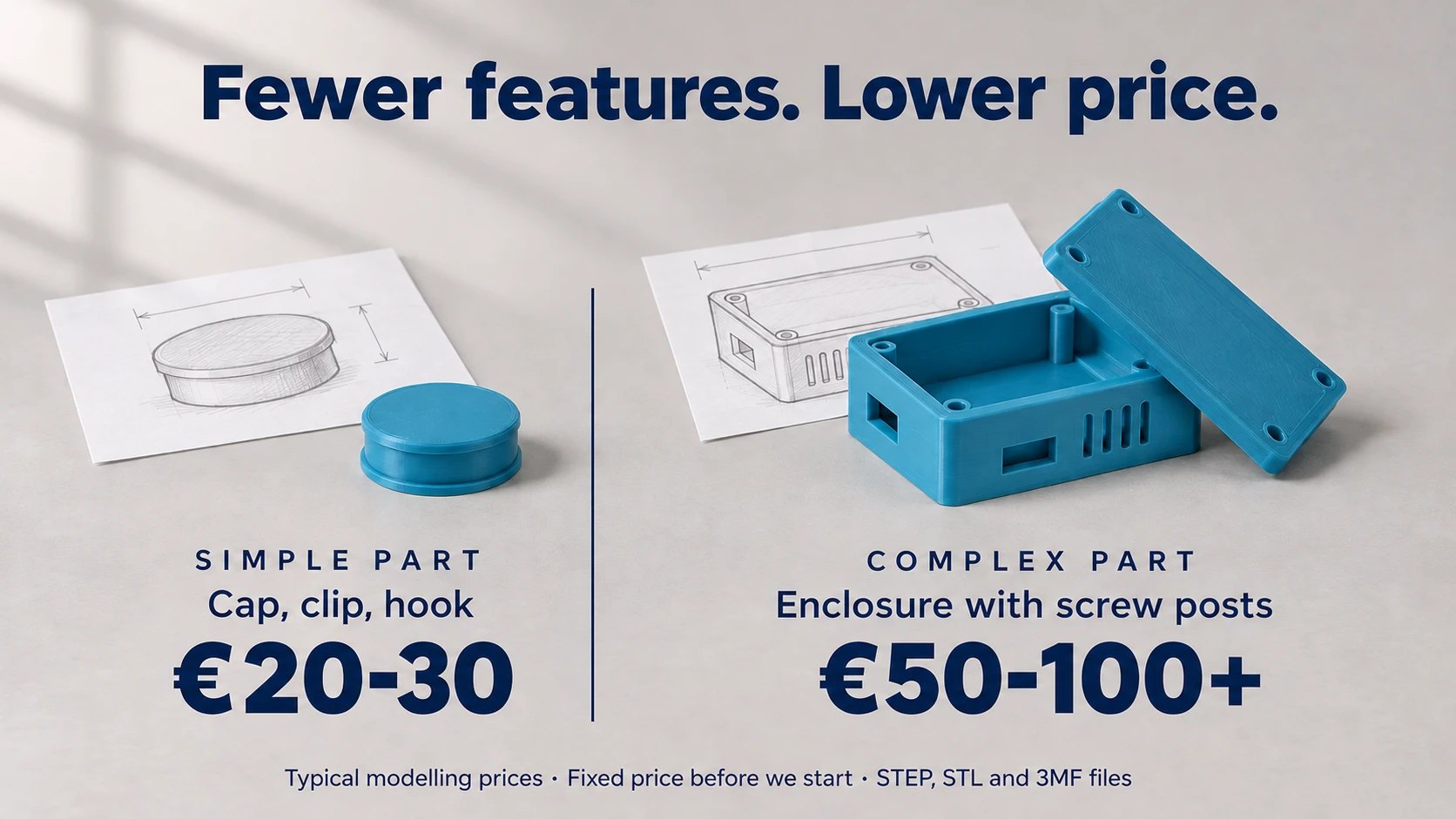
At Eksaria, modelling a simple part usually costs €20 to €30. More complex parts usually land between €50 and €100, and some go beyond that. The final price depends mostly on how much drawing and measuring your part takes.
Typical prices
| Type of part | Examples | Typical price |
|---|---|---|
| Simple | A cap, clip, hook, spacer or simple bracket | €20 to €30 |
| More complex | A door handle, an enclosure with screw posts, a part with threads or snap fits, several parts that fit together | €50 to €100, sometimes more |
These are typical prices as of November 2026, not a price list. Every project gets its own fixed price before we start, so there are no surprises at the end. We don't currently charge VAT, so nothing is added on top.
Printing is priced separately. When the files are ready, you upload them to our quoter like any other part and see the print price in a few moments. Our guide to 3D printing costs has real examples of what printing costs.
What you get
We design every part in Fusion with the dimensions you need, and we send previews along the way, so you can ask for changes before it's finished. At the end you get print-ready STEP, STL and 3MF files. STEP opens in almost any CAD program, so you or anyone else can change the part later.
We also set the print orientation and settings that suit the part, add assembly notes when there are several pieces, and include commercial rights on every design. The files are yours. Print them with us or anywhere else, as often as you like, without paying for the model again.
What makes one model cost more than another
The shape
Flat faces, straight edges and round holes are quick to draw. Curved surfaces, smooth transitions and shapes that have to sit well in the hand, like a grip or a handle, take far longer.
The number of features
Every hole, thread, rib, cut-out, snap fit and piece of text is extra work. A plain spacer has one or two features. An electronics enclosure can easily have dozens: screw posts, openings for cables and buttons, vent slots and a lid that has to fit.
What you send us
A drawing with every dimension is the quickest starting point. Photos and measurements of an existing part take longer, because we first have to work out its exact shape and check each measurement. A rough idea with no dimensions takes longest, because making the design decisions becomes part of the job.
How precisely it has to fit
A part that stands on its own is easier than one that has to fit something you already own, such as a clip that snaps into a slot or a bracket whose holes must line up with existing screws. Our prints are usually accurate to within ±0.2 mm, and parts that slide into each other need a gap of about 0.2 to 0.3 mm. Getting that right takes careful measuring, and for a tight fit we'd usually suggest one test print before you order more.
How many parts there are
An assembly of parts that work together, or a large part split into pieces, takes longer than a single part, because every piece has to fit the others.
Not every job starts from zero
Besides designing new parts, we rebuild existing ones as accurate CAD models from measurements, photos or a drawing. That's called reverse engineering, and it's the usual route for replacement parts you can't buy anywhere. We also repair files that have holes or errors and won't print, and prepare large models for printing by splitting them into pieces with joints that fit together. These jobs are priced the same way: you send what you have, and we reply with a fixed price before we start.
How it works
- Describe the part and what it's for in the form on our 3D modelling page, and attach any sketches, photos or files.
- We get back to you within 1 to 2 working days with a fixed price and a delivery date.
- We model the part and send previews, so you can ask for changes.
- You get the files and can order the print right away in the quoter.
How to keep the price down
The clearer the request, the less time the model takes. A few things make a real difference:
- Send the main dimensions. The most important are the overall length, width and height, hole diameters and the distances between hole centres. For small parts, a digital calliper is far more accurate than a ruler.
- Take good photos. Shoot every side straight on, with a ruler next to the part, in good light and against a plain background.
- Say what has to be exact and what only has to be roughly right.
- Explain what the part does. What does it attach to, what load does it carry, and will it be indoors, outdoors or somewhere warm?
- Leave out decoration if the part only has to work. Logos, text and decorative curves all add time.
And before you pay anyone, search Printables, Thingiverse and MakerWorld. For a lot of everyday items, someone has already designed the part, and printing a free model costs nothing extra.
Is it worth paying for?
It usually is when the part doesn't exist anywhere else: a replacement that's no longer sold, a custom bracket or housing for your own project, a prototype of a product idea. You pay for the design once, and every copy after that costs only the print.
You can of course design it yourself. Tinkercad is free and made for beginners, and Fusion, Onshape and FreeCAD suit technical parts. It costs nothing but your time, though for a part that has to fit something exactly, that can be quite a lot of time.
One thing to watch when you compare prices online: "3D modelling" also covers models for games, animation and product renders. Those only have to look right on screen. A model for printing has to be a closed, solid shape with exact dimensions, or it won't print properly or fit where it should. That's the kind of modelling we do, and the kind these prices are for.
Frequently asked questions
How much does it cost to have a simple part modelled?
Usually €20 to €30 for something like a cap, clip, hook or spacer. You get a fixed price for your part before we start.
Can you make a 3D model from a photo?
Only if you also send measurements. A photo shows the shape but not the size. Photograph the part next to a ruler and add the main dimensions, and we can work from that.
Is printing included in the modelling price?
No. The modelling price covers the design and the files. You see the print price in the quoter once the files are ready.
Do I have to print the part with you?
No. The files are yours, and so are the commercial rights, so you can print and even sell the part wherever you like.
Get a price for your part
Tell us about the part on our 3D modelling page and attach whatever you have, even a rough sketch with a few measurements. We'll get back to you within 1 to 2 working days with a fixed price. Already have a print-ready file? Then skip all this and upload it to the quoter.
Ready to price your part? Upload a file and get a quote in a few moments.
Open quoter